
Refractive Lens Exchange Cost: What You’re Actually Paying For
Refractive lens exchange costs more than LASIK, and it retires a cataract surgery later. What shapes the price, how lens choice moves it, and how I would weigh it.

Refractive lens exchange has a reputation as the premium option with the premium price. Both halves of that deserve a closer look.
You may also see RLE called lens replacement surgery. The name fits: a lens that has aged is exchanged for a new one.
RLE is the same operation as modern cataract surgery, done earlier, by choice, with a lens you help select.
Once you see it that way, the cost reads differently. You are moving forward a surgery that many people need later in life anyway.
I do not publish prices, because an honest one depends on your eyes and your lens. What I can do is show you what the number is made of.
What is refractive lens exchange?
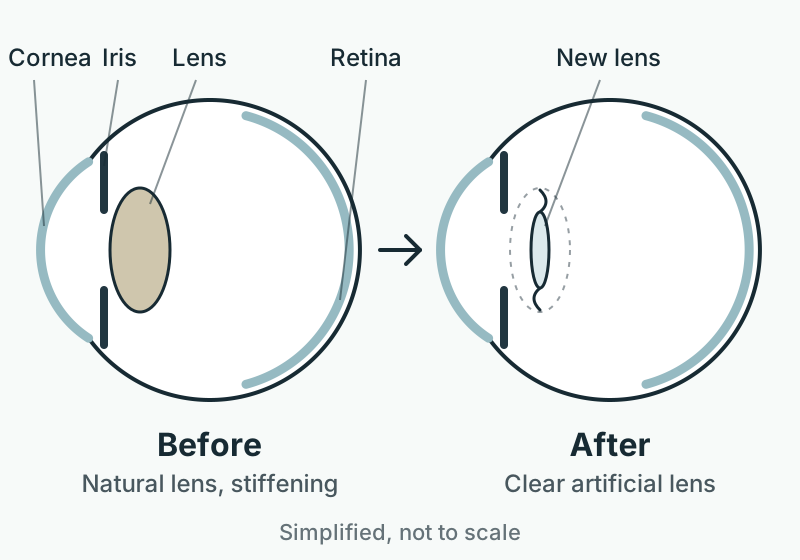
Behind your iris sits a clear natural lens. When you were young it flexed easily, which is how you shifted focus from far to near.
The National Eye Institute explains that with age the lens gets harder and less flexible, usually after age 45.
That is presbyopia. It is why the menu drifts farther away, and why readers turn up in every room of the house.
Laser vision correction reshapes the cornea, the clear window at the front of the eye. It cannot restore a lens that has stopped flexing.
RLE goes to the source. I remove the natural lens through a tiny opening and place a precise artificial lens in the same pocket.
Your prescription lives in the new lens, and for many patients that includes reading vision.
Who lens replacement surgery suits, and who should wait
RLE is usually the right conversation in your mid-forties or beyond, when reading vision is fading or already gone.
It also helps people whose prescription falls outside what a laser can safely treat, in either direction.
And it makes sense when your eye exams already show early changes in the lens.

If you are thirty-two with a healthy, flexible lens, this is probably not your procedure. LASIK, PRK, or EVO ICL will likely serve you better.
There is no single right age. Your corneas, retinal health, dry eye status, and how you spend your days all carry weight.
I compared the options for this stage of life in Vision Surgery in Your 40s and 50s.
Sometimes my advice is to wait. If waiting serves your eyes better, that is what you will hear from me.
RLE vs. LASIK: why RLE eye surgery costs more
- It is surgery inside the eye, performed in an operating suite instead of a laser room
- The lens itself is part of the price, and advanced lenses cost more than standard ones
- Lens power calculations depend on meticulous measurements before surgery
- Each eye is its own procedure, scheduled separately
None of that is padding. Each item changes what happens to your eyes on the day, and in the years after.
How your lens choice moves the cost of RLE
The lens is the biggest variable in any RLE quote. It is also the part you have the most say in.
The American Academy of Ophthalmology keeps a plain-language guide to the types of replacement lens. Here is the short version.
- Monofocal lenses have one focusing distance. Most people set them for distance and wear glasses to read
- Multifocal lenses provide distance and near focus at the same time, through zones of different power
- Extended depth of focus lenses use one corrective zone, stretched to cover a range
- Toric lenses correct astigmatism
- The Light Adjustable Lens can be fine-tuned with light after surgery
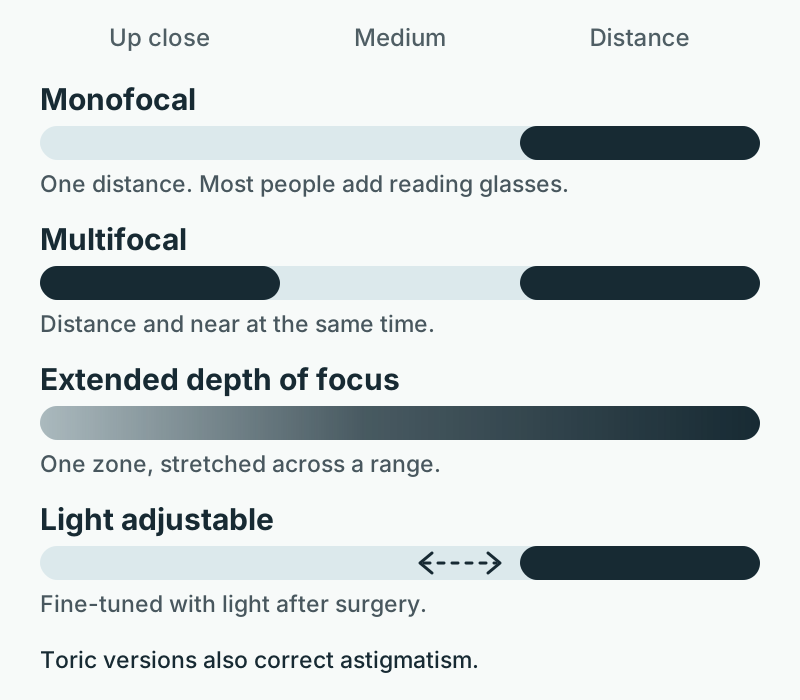
A standard monofocal lens costs the least. Lenses that also cover near vision cost more to make and to fit.
Blended vision and the Light Adjustable Lens
Some of my patients choose blended vision instead, with one eye favoring distance and the other favoring near.
With the Light Adjustable Lens, that balance can be refined after surgery, once you have lived with your new vision for a while.
Before anything is final, I can demonstrate blended vision with trial lenses, so you can feel it in your real life first.
There is no single right lens. There is a right lens for how you live, and finding it takes an unhurried talk.
RLE vs. cataract surgery: the math most people miss
Here is what the price tag does not show. RLE is usually done once.
Cataracts form only in the natural lens. Once that lens is replaced, a true cataract cannot form in that eye.
So cataract surgery, and its cost, comes off your future list. Very few purchases in medicine retire a later expense outright.
One honest footnote: the thin membrane behind the implant can cloud months or years later. It is not a new cataract.
When that happens, it is treated with a brief outpatient laser procedure.
Then add the glasses. Progressive lenses are among the most expensive glasses you can buy, and prescriptions keep moving in your fifties.

Readers multiply too: one in the kitchen, one in the car, one by the bed.
None of that appears on a surgical quote. All of it belongs in the comparison.
Three paths, compared honestly
RLE now
One procedure, a lens chosen for your life, freedom from readers and progressives for most of your day, and no cataract later.
The cost comes up front, and it is surgery inside the eye, which deserves a serious conversation.
LASIK or PRK now, cataract surgery later
This can suit a younger lens that still flexes well. It corrects distance and leaves reading vision to age on its usual schedule.
It also means two procedures over a lifetime instead of one.
Glasses until cataracts arrive
This is a perfectly reasonable choice. It costs nothing today and keeps every option open.
What it costs is spread out: years of progressives and readers, and night driving that slowly gets harder.
At your consultation I will tell you which of the three I would choose in your position, and why.
Is refractive lens exchange covered by insurance?
RLE chosen to reduce your dependence on glasses is generally considered elective, so most health plans do not cover it.
FSA and HSA funds, often combined with financing, are how most of my patients approach it.
I cover the details in Does Insurance Cover LASIK, EVO ICL or Refractive Lens Exchange?
If the year is ending, check your FSA balance before it resets.
What your RLE surgery quote should include
- A complete set of measurements: corneal mapping, biometry, tear film, and retinal health
- My recommendation on lens type, with the trade-offs explained plainly
- The procedure for each eye, medications, and all follow-up visits
- A clear answer on what happens if your vision needs fine-tuning afterward
A quote that leaves out one of those four is incomplete, however low it looks.
If you are comparing practices, ask each one the same three questions and write the answers down.
- Who takes my measurements, and who explains them to me?
- Which lens are you recommending for my eyes, and what would you choose in my place?
- What care is included after surgery, and for how long?
The differences between the answers will tell you more than the difference between the prices.
Ask about the time as well. Plan on a short operation for each eye, with most patients back to normal life in a few days.
Talk through refractive lens exchange in Omaha
At Aviva in Omaha, RLE consultations are with me, and they are unhurried.
I will show you your own measurements and explain what your lens is doing.
No lens is chosen until you understand why it fits your life.
You will not be asked to decide that day. Take the quote home and compare it with anyone’s.
This is a decision about the next thirty years of your vision. It deserves at least an hour.
Consultations are complimentary, Monday through Friday. Bring your current glasses and your questions. Both are useful.
Book a complimentary consultation whenever you are ready.
Questions, answered
Is RLE ever covered by vision plans?
RLE chosen to reduce dependence on glasses is generally an elective procedure.
Some vision plans offer member discounts. A discount is not coverage, but it can lower the total.
FSA and HSA funds and financing are how most patients approach it. We can walk through all of it at your consultation.
Why do lens choices change the price so much?
Advanced lenses that cover near and distance vision cost more to make and to fit.
They are also what make life without readers possible, so the choice deserves a real conversation.
I explain the trade-offs of each option before any decision is made.
Does RLE really prevent cataracts?
Yes. Cataracts form in the natural lens, and RLE removes it.
The artificial lens that replaces it cannot develop a cataract.
How do I know if I’m better suited to RLE or LASIK?
Mostly age, and how your natural lens is aging. Past the mid-forties, the lens is often the real problem.
Measurement settles it. I will show you your own results and explain why one procedure fits.
More from Learn
 Procedures
Vision Surgery in Your 40s and 50s: LASIK After 40, Monovision and RLE
After 40, the reading-glasses problem changes the vision surgery conversation. LASIK, monovision, blended vision, and RLE, matched to the decade you’re in.
 Procedures
Choosing Your Cataract Lens
Multifocal, Trifocal, Extended Depth of Focus, Light Adjustable, and Toric Lenses Compared
 Procedures
Is LASIK Worth It? The 20-Year Math vs Contacts and Glasses
Contacts and glasses are a subscription you never stop paying. How I walk patients through the twenty-year math, what LASIK really buys, and how long LASIK lasts.