
Is LASIK Worth It? The 20-Year Math vs Contacts and Glasses
Contacts and glasses are a subscription you never stop paying. How I walk patients through the twenty-year math, what LASIK really buys, and how long LASIK lasts.

“Is it worth it?” is the most honest question I hear about LASIK eye surgery, and it deserves a careful answer.
Most people who ask have already done some version of the math in their heads, usually while cleaning a lens late at night.
So let me walk through it the way I would across the desk from you in Omaha: the money, the parts that are not money, and the limits.
I will leave out dollar figures on purpose. Yours are the only ones that matter, and you already have the receipts.
LASIK vs. contacts: the subscription you forgot you are paying
Contacts feel affordable because they arrive as small charges spread across the year.
There are the boxes of lenses, the solution, the rewetting drops, and the fitting exam that renews the prescription.
Glasses sit on top of that: a backup pair, new lenses when the prescription shifts, and prescription sunglasses for the car.
None of it feels like much in any one month. All of it repeats, every year, for as long as you wear them.
LASIK is the opposite shape. You pay once, and then that line in the budget goes quiet.
So the fair comparison is between two shapes of the same spend: one stretched over decades, and one paid up front.
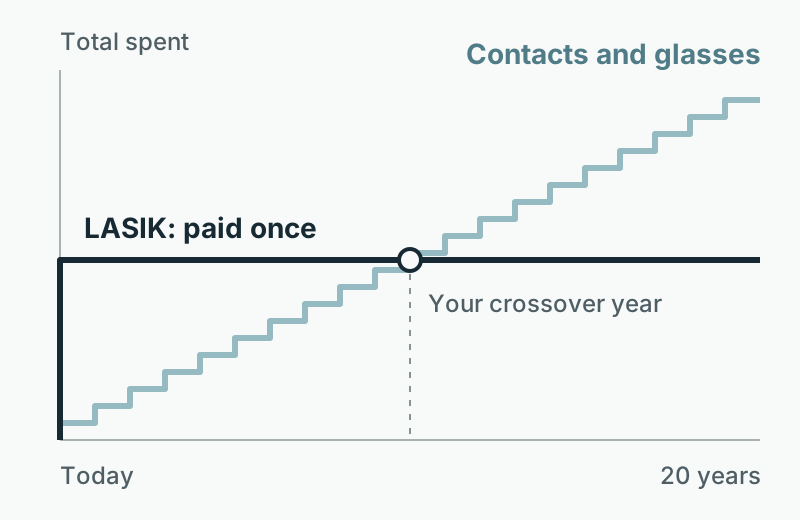
Where the two lines cross is different for everyone. Daily disposable lenses get there fastest.
Someone who wears one pair of glasses for years will take much longer, and should know that going in.
Is LASIK worth the money? A worksheet for your own numbers
Here is the worksheet I suggest. It takes one page and about fifteen minutes with your bank statements.
- Add up a full year of contact lenses, including the boxes you bought in a hurry while traveling
- Add solution, lens cases, and rewetting drops
- Add your contact lens fitting and the exam that goes with it
- Add glasses: frames, lenses, prescription sunglasses, and repairs, averaged per year
- Multiply that yearly total by twenty

Most people are surprised by the last line. Small charges hide well.
Bring that number to your consultation. I would rather compare a real quote with your real spending than with a national average.
If you want to see how a quote is built before you come in, I wrote about what drives LASIK eye surgery cost in Omaha.
If you have an FSA or HSA, those funds can typically go toward laser vision correction, which changes the math again.
The costs that are not money
Most of my patients tell me afterward that the arithmetic was not what decided it.
- Mornings that start with hunting for glasses or working a lens in
- Contacts that give out at hour twelve, right when the evening starts
- Lenses that fog when you step into a warm building in an Omaha January, and frames that slip in July
- The low hum of managing it all: reordering, cleaning, replacing, remembering
None of that shows up on a receipt, and all of it is real.
Then there is water. The American Academy of Ophthalmology puts it plainly: water and contacts do not mix.
That covers showers, pools, hot tubs, and lakes. I watch careful people bend that rule every summer.
For some people the whole reason is a five a.m. lake trip without fumbling for anything, or rain on a bike ride that does not blind them.

What contact lenses ask of your eyes
Contact lenses are safe when they are cared for properly. The catch is that proper care is a daily job, for decades.
The Academy’s guide to taking care of contact lenses is worth reading even if you never have surgery.
It warns that lenses cleaned or stored incorrectly can lead to a serious eye infection.
It also notes that old or poorly fitting lenses can scratch the eye, and that the case should be replaced at least every three months.

I am not telling you contacts are dangerous. I am telling you their upkeep is a real cost, and it belongs on the ledger.
If contacts are part of why your eyes feel dry by evening, write that down too. Many people are more comfortable without them.
What LASIK eye surgery actually buys
For eyes that are good candidates, LASIK buys years of clear distance vision without glasses or contacts.
The treatment is short. At Aviva it is typically finished in less than thirty minutes, and you stay comfortable throughout.
Most of my LASIK patients see clearly the next morning and feel ready for work.
Set against twenty years of lens logistics, that is a small interruption.
Are people happy after LASIK? What the FDA found
You do not have to take a surgeon’s word for how people feel after LASIK. The FDA studied it.
With the National Eye Institute and the Department of Defense, it ran the LASIK Quality of Life Collaboration Project.
In those studies, more than 95 percent of participants were satisfied with their vision after surgery.
The same studies are honest about the other side. New visual symptoms such as halos, and dry eye symptoms, were common at three months.
Fewer than 1 percent of participants had a lot of difficulty with their usual activities because of those symptoms.
I share both halves with every patient, because a decision this size should be made with the whole picture.
It is also why I measure your corneas and your tear film so carefully before I recommend anything.
How long does LASIK last?
This is the question underneath the question. People want to know whether they will be back in glasses in ten years.
Is LASIK permanent?
The reshaping of the cornea is permanent. The distance correction itself does not wear out.
What keeps changing is the natural lens inside your eye, which ages in everyone whether or not they ever had surgery.
So expect reading glasses to arrive somewhere in your forties, the same as they do for friends who never needed glasses at all.
LASIK does not cause that, and it cannot prevent it. It is a separate change in a different part of the eye.
What about a LASIK enhancement?
Occasionally a prescription drifts years later. When it does, an enhancement is often possible, and we would measure your corneas again first.
In the twenty-year math, that means LASIK covers your distance vision for the long run, and readers are a smaller, later line.
LASIK alternatives, for when LASIK is not the answer
Some eyes should not have LASIK, and finding that out is part of what a good consultation is for.
Thin or irregular corneas, a prescription outside the safe range, or significant dry eye can each point somewhere else.
That is rarely the end of the conversation. PRK reshapes the cornea without a flap, and suits some eyes that LASIK does not.
EVO ICL corrects vision with a lens placed inside the eye, and it is often the better fit for strong prescriptions.
Is LASIK worth it after 40?
It can be. Reading glasses arrive in your forties with or without LASIK, so they belong in the math from the start.
Past the mid-forties, a lens-based procedure is often the wiser investment, because it treats the lens that has started to age.
If you are not sure where you fall, our two-minute self-test is a gentle place to start.
The goal was never LASIK itself. The goal is lasting freedom from glasses and contacts, by whichever route fits your eyes.
Bring your numbers to a LASIK consultation in Omaha
Bring your worksheet to a consultation at Aviva. I will measure your eyes, confirm whether you are a candidate, and give you a real figure.
Then the question stops being abstract, and you can set one number beside the other.
The consultation is complimentary and unhurried, Monday through Friday.
If the answer is no, you will leave knowing why, and knowing more about your eyes than when you arrived.
Book a complimentary consultation whenever you are ready.
Twenty years is a long time to keep paying for the same problem. It is worth one careful hour to find out whether you have to.
Questions, answered
How long do LASIK results last?
The corneal reshaping is permanent, and the distance correction does not wear out.
Your eyes still age. Reading vision changes in mid-life for everyone, with or without LASIK.
What if my prescription changes later?
Part of candidacy is confirming that your prescription has been stable for at least a year.
If your eyes shift years down the road, an enhancement is often possible. Ask how we handle that at your consultation.
Are there people LASIK isn’t worth it for?
Yes, and I will tell you if you are one of them.
If your corneas, prescription, or tear film point away from LASIK, the money is better spent elsewhere.
PRK, EVO ICL, or refractive lens exchange usually covers the eyes that LASIK does not.
Does insurance help with LASIK?
LASIK is generally considered elective, but FSA and HSA funds typically apply, and financing can spread the rest.
Bring your plan details to your consultation and we will sort out what applies.
More from Learn
 Procedures
Vision Surgery in Your 40s and 50s: LASIK After 40, Monovision and RLE
After 40, the reading-glasses problem changes the vision surgery conversation. LASIK, monovision, blended vision, and RLE, matched to the decade you’re in.
 Procedures
Choosing Your Cataract Lens
Multifocal, Trifocal, Extended Depth of Focus, Light Adjustable, and Toric Lenses Compared
 Procedures
PRK vs LASIK for Active Lifestyles
Same laser, same destination, a different road there. How PRK and LASIK differ, what PRK recovery asks of you, and who each one suits, from an Omaha surgeon.