
Vision Surgery in Your 40s and 50s: LASIK After 40, Monovision and RLE
After 40, the reading-glasses problem changes the vision surgery conversation. LASIK, monovision, blended vision, and RLE, matched to the decade you’re in.

At some point the surgery question stops being only about LASIK, and refractive lens exchange joins the list.
After 40, the reading-glasses problem changes the vision surgery conversation entirely.
LASIK, monovision, blended vision, and refractive lens exchange (also called dysfunctional lens replacement), each matched to the decade you are in.
I see this conversation every week in my Omaha practice, at every stage of the decade.
Somewhere in your mid-forties, your arms quietly stop being long enough for the fine print.
The menu drifts backward. The phone font grows. Readers colonize the house, one room at a time.
It arrives on schedule for practically everyone, and it is famously unbothered by your opinion of it.
That is presbyopia, the natural stiffening of the eye’s lens and its surrounding white outer shell, the sclera.
It changes the surgery conversation completely.
It happens to everyone, including people who have never worn glasses a day in their lives.
The procedures that fit at 28 are not automatically the ones that fit at 48.

Presbyopia: why 40 is a turning point
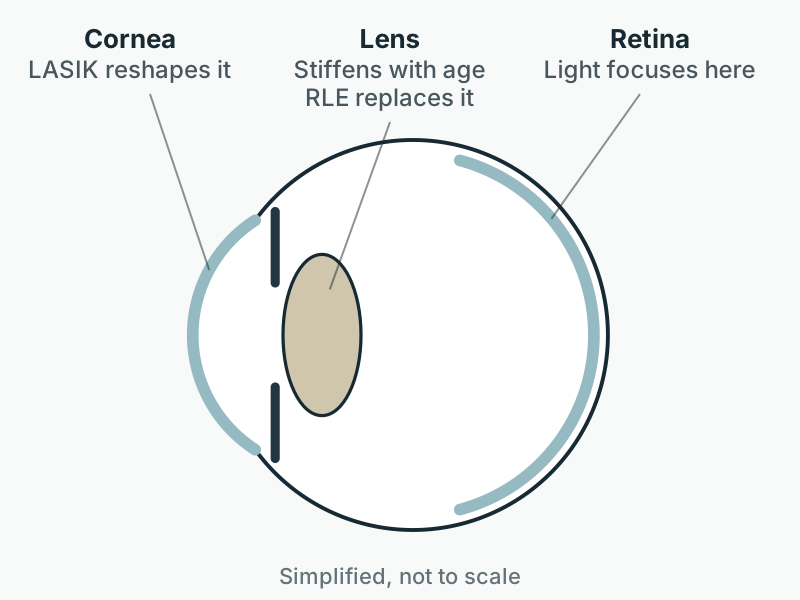
Standard LASIK corrects your distance vision by reshaping the cornea.
It does nothing for a lens that has stopped flexing, and after 40, that is the part failing.
How presbyopia changes your focus
The National Eye Institute describes presbyopia as a normal part of aging that usually shows up after 45.
As the lens gets harder and less flexible, it stops focusing light correctly on the retina, and nearby things blur.
You probably know the early signs already. Reading matter drifts farther from your face, and your eyes tire or ache.
Early on, brighter light and bigger type help. As it progresses, you will probably need glasses or contact lenses to read.
It keeps progressing for years and usually stops getting worse after 65.
Many people have another refractive error on top of it, so a distance prescription and a reading problem often share the same eyes.
Checking for it is part of a comprehensive eye exam, which is simple and painless.
LASIK after 40: still on the table
Plenty of people in their forties are excellent LASIK candidates, with eyes-open expectations.
If you have worn distance glasses your whole life, freeing your daytime vision may be well worth it, readers and all.
Driving, sports, travel, the pool with your kids. All of it glasses-free, with cheaters for the fine print.
The math shifts through the decade as presbyopia deepens. Timing matters.
At 40, LASIK may buy ten to fifteen great years. At 55, the lens conversation usually deserves to lead.
I walk every patient through that math honestly, in their own numbers, before we decide anything.
How long does LASIK last after 40?
The corneal reshaping itself is permanent.
What keeps changing is the lens behind it. Distance vision can stay crisp while close-up focus keeps slipping.
So those ten to fifteen years are not a countdown on the laser work. They are the window before the lens takes over the conversation.
Will I need reading glasses after LASIK?
If both eyes are set for distance, plan on readers for fine print at some point, if a pair is not on your nightstand already.
LASIK does not cause that change, and it cannot stop it. The lens ages on its own schedule.
Some people happily keep readers in the car and by the bed. Others would rather plan for near vision from the start.
Monovision and blended vision
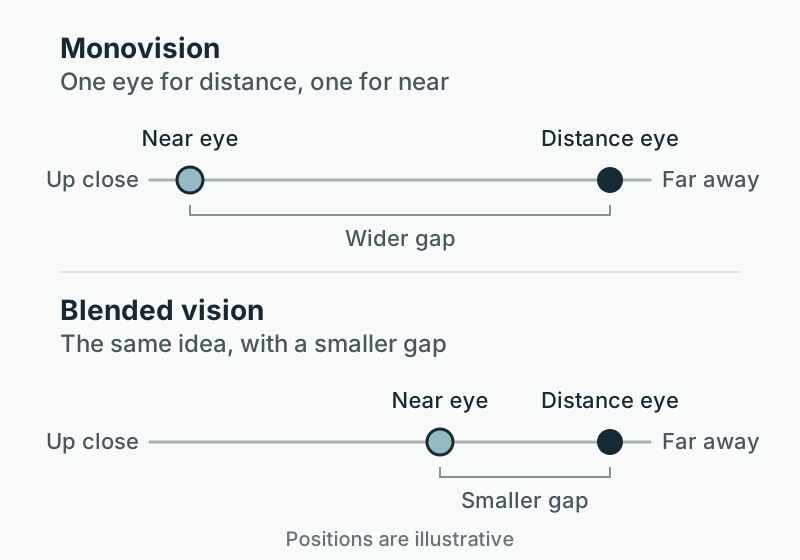
One elegant compromise: correct one eye for distance and its partner slightly nearer.
Your brain learns to blend the two, and most of daily life happens comfortably without glasses at all.
Blended vision is the modern, gentler tuning of the old monovision idea, with a smaller gap and easier adaptation.
It can be built into your lens choice.
Some people adapt to it instantly and forget which eye is which. A minority never quite love it.
The good news: you can test-drive it during your consultation with me before committing to anything surgical.
How monovision works with LASIK or a lens implant
Most people have a dominant eye, the one you would keep open if you had to close the other.
In monovision or blended vision, that eye is corrected for distance and its partner is left a little nearsighted for close work.
It can be done with contact lenses, with LASIK, or with the lens implants used in lens exchange and cataract surgery.
Two trade-offs come with it. You may lose some depth perception, and you may still want readers for small print.
Trying monovision with contact lenses first
Some people simply cannot adapt to monovision. That is why eye doctors usually suggest trying it with contact lenses before any surgery.
A trial in your real life tells you more than any explanation: at your desk, on the drive home down Dodge Street, with a book on the couch.
If it feels natural, it can be built into LASIK or a lens plan. If it does not, you found out before anything was permanent.
When refractive lens exchange becomes the honest answer
Refractive lens exchange, also known as dysfunctional lens replacement, replaces the aging lens itself.
It goes in as a modern multifocal, extended-range, or light-adjustable lens, before it ever becomes a cataract.
It treats the cause, not the symptom: distance and near, addressed in one procedure.
An eye that has had this procedure will also never develop a cataract, which quietly retires a future surgery.
Which lens fits is its own conversation, and I give it the time it deserves.
Choosing your RLE lens
The lens families are the same ones people compare when choosing a cataract lens, and so are the questions about how you spend your days.
Astigmatism correction can be built into the lens if you need it.
With the Light Adjustable Lens, blended vision can even be fine-tuned after surgery, once you have lived with it, and then locked in.
RLE vs LASIK: when the lens should lead
In my planning, lens exchange moves ahead of LASIK once reading fades or a prescription sits outside what a laser can safely treat.
An exam that shows the lens starting to change tips it too. Some people simply prefer one lasting change to years of temporary ones.
If none of those fit yet, LASIK or monovision can carry you comfortably for years first.
So which one is yours?
It depends on your prescription, your lens’s age, your corneas, and how you actually spend your days.
That is not a dodge. It is the reason consultations exist.
Two 48-year-olds with identical prescriptions can leave with entirely different plans, both correct.

Planning vision correction after 40 in Omaha
The consultation measures the shape and thickness of your corneas, the health of your tear film, and the state of your lens.
Bring your readers, your distance glasses, and a list of what you most want to see without them.
Golf in Elkhorn, the scoreboard at a Creighton game, a novel on a winter night: those details shape the plan as much as the maps do.
At Aviva, I look at the health of your eyes with precise measurements, and walk you through your options honestly, whatever decade you are in.
Book a complimentary consultation or read the RLE overview first.
The readers multiplying around your house are a symptom. There is a plan for the cause.
The right procedure at the right age is a quiet superpower. Let’s find yours.
Questions, answered
Am I too old for LASIK?
There is no upper age cutoff, candidacy is about eye health and honest expectations.
The real question after 40 is whether LASIK, monovision, or refractive lens exchange best fits your lens’s age.
What exactly is blended vision?
A refinement of monovision: one eye tuned for distance, the other modestly nearer, with a smaller gap between them.
It is covered as an option within refractive lens exchange and laser-vision planning, and you can test-drive it during your consultation.
Is refractive lens exchange the same as cataract surgery?
Surgically it is essentially identical, the difference is timing and intent.
Refractive lens exchange swaps the lens before a cataract forms, on your schedule instead of the cataract’s.
Can I just keep buying readers?
Of course, presbyopia is inconvenient, not dangerous.
Surgery is for the moment the inconvenience outweighs the fix. You will know when that is.
More from Learn
 Procedures
Choosing Your Cataract Lens
Multifocal, Trifocal, Extended Depth of Focus, Light Adjustable, and Toric Lenses Compared
 Procedures
Is LASIK Worth It? The 20-Year Math vs Contacts and Glasses
Contacts and glasses are a subscription you never stop paying. How I walk patients through the twenty-year math, what LASIK really buys, and how long LASIK lasts.
 Procedures
PRK vs LASIK for Active Lifestyles
Same laser, same destination, a different road there. How PRK and LASIK differ, what PRK recovery asks of you, and who each one suits, from an Omaha surgeon.