
Choosing Your Cataract Lens
Multifocal, Trifocal, Extended Depth of Focus, Light Adjustable, and Toric Lenses Compared

Modern cataract surgery in Omaha is more than removing a cataract.
It is an opportunity to choose a lens designed around the way you live, see, and want to experience the world.
Cataract surgery removes a cloudy lens.
The decision that can shape how you see for years to come is the lens that takes its place.
Today, you have meaningful choices. The best lens is not simply the most advanced option.
It is the one that fits your eyes, your lifestyle, and the moments you most want to see clearly.
I will guide you through that decision with the time, honesty, and attention it deserves.
What Is an Intraocular Lens (IOL)?
The lens that takes the cataract’s place is called an intraocular lens, or IOL. It sits in the same pocket your natural lens occupied.
The American Academy of Ophthalmology keeps a plain-language guide to intraocular lens types, and most of the options below appear in it.
Like glasses, IOLs come in different focusing powers. I set yours from measurements of the length of your eye and the curve of your cornea.
Most are made of acrylic, silicone, or another plastic, with a coating that helps shield your eye from ultraviolet light.
Where the types differ is in which distances they cover, whether they correct astigmatism, and whether they can be adjusted.
Monofocal Lenses
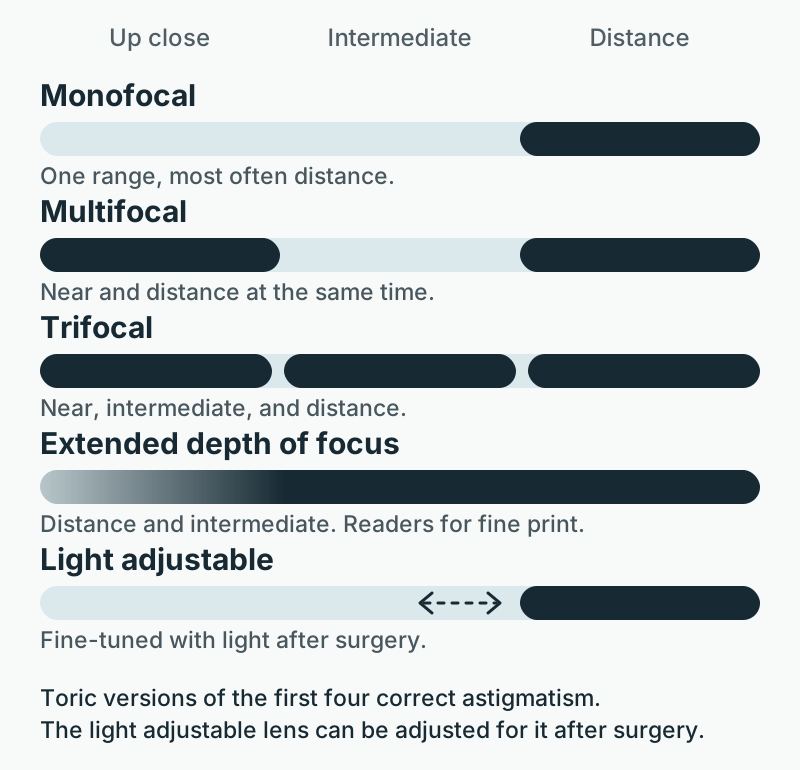
A standard monofocal lens is designed to provide clear vision for one focal range, most commonly for seeing things farther away.
Depending on your prescription and visual goals, you may still use glasses for distance, computer work, reading, or all three.
A standard monofocal lens does not correct astigmatism that originates in the cornea.
However, it is a trusted, time-tested option for patients who value crisp, dependable vision.
That includes patients comfortable using glasses for the activities outside their selected focal range.
For many people, this is exactly the right fit. It offers clarity, simplicity, and reliable vision.
Monovision With Monofocal Lenses
A monofocal lens does not have to be set for distance. The Academy notes it can be set for up close, medium range, or distance.
Some patients choose monovision: one eye set for distance and the other for near, so the two eyes share the work.
Whether it suits you depends on your measurements and how your brain adapts. I can demonstrate it with trial lenses before anything is decided.
Multifocal and Trifocal Lenses
Multifocal and trifocal lenses are designed to offer a broader range of vision, including near, intermediate, and distance activities.
The Academy calls these presbyopia-correcting lenses. Zones of different power sit within one lens, so more than one distance is in focus at once.
For patients who hope to read, use a computer, and see their phone with less reliance on glasses, this can be appealing.
The trade-off is that some patients notice halos, glare, or reduced contrast in dim light, particularly while driving at night.
Many people adapt well, but it is important to discuss how much night driving is part of your life and how you feel about that possibility.

Extended Depth-of-Focus (EDOF) Lenses
Extended depth-of-focus lenses offer a middle ground.
Instead of separate zones, an EDOF lens has one corrective zone stretched to cover a range, which may mean less effort shifting focus.
They are designed to provide strong distance and intermediate vision, helpful for driving, computer work, and cooking.
They involve fewer night-vision compromises than some multifocal or trifocal designs.
Reading glasses may still be needed for fine print and prolonged close work.
For many patients, this balance feels just right.
The Light Adjustable Lens
The Light Adjustable Lens offers something most other lens implants cannot: the ability to fine-tune your vision after surgery.
With a traditional lens implant, the prescription is selected before surgery and remains fixed afterward.
With the Light Adjustable Lens, we can see how your eye heals and how you are actually seeing in daily life before finalizing your vision.
Once your eye has healed, you return for a series of gentle, targeted light treatments in the office.
Those treatments allow us to make small adjustments to the lens based on your real-world visual outcome, not only a preoperative prediction.
When you are happy with the result, final light treatments lock in your prescription.
It is a more personalized approach to lens surgery: one that gives us the opportunity to refine your vision around the life you actually live.
How the Light Adjustable Lens Is Adjusted
The FDA approved the Light Adjustable Lens in 2017 and described how the adjustments work.
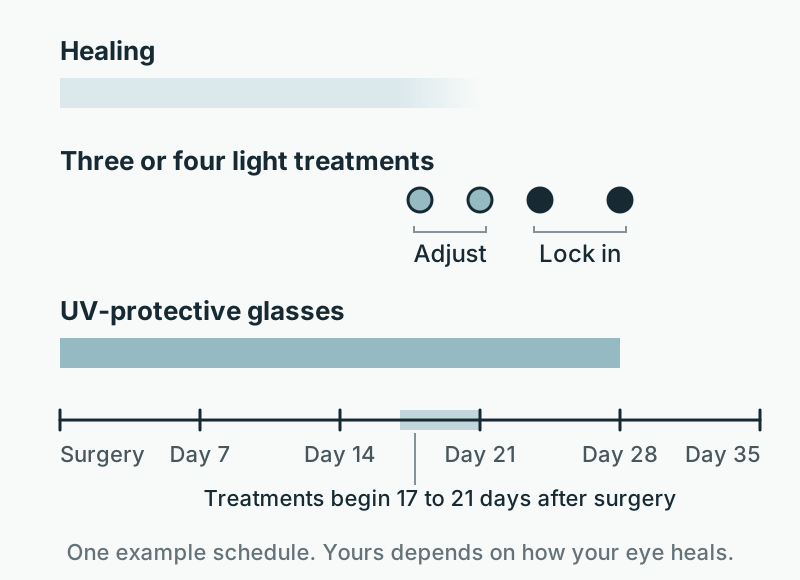
The lens is made of a material that responds to ultraviolet light. Treatments begin 17 to 21 days after surgery.
Patients have three or four light treatments over one to two weeks, each lasting less than three minutes.
Until the last one, you wear special UV-protective glasses, so daylight cannot change the lens before we do.
The study behind that approval included 600 patients and compared the adjustable lens with a conventional one.
Six months after surgery, distance vision without glasses was about one line better on the chart, on average, with the adjustable lens.
The FDA notice says the lens is intended for patients who have astigmatism in the cornea before surgery.
In the study, three in four also had less astigmatism six months after surgery.
It means a few extra visits. In return, you see the result in your real life before it is locked in.
Toric Lenses and Astigmatism
Astigmatism can blur vision at every distance or focal range.
The Academy describes astigmatism as an uneven curve in the cornea or the lens.
A toric lens is designed to correct it and can often be paired with monofocal, multifocal, trifocal, or extended depth-of-focus lens designs.
If your measurements show meaningful astigmatism, correcting it can make a meaningful difference in the sharpness of your vision after surgery.
What Insurance Covers, and What Costs More
Because it treats a clouded lens that is affecting your sight, cataract surgery itself is usually covered by insurance.
The lens is where your share can grow. The most common cataract lens is a monofocal, and the premium designs cost more.
If part of the cost falls to you, FSA and HSA funds and financing can make it easier to manage.
How to Choose Your Cataract Lens
Your eye measurements matter, but so does your life. Do you read often? Drive at night?
Spend long hours at a computer? Love golf, travel, cooking, or time outdoors?
Do you see reading glasses as an inconvenience and something you would truly prefer to leave behind?
There is no universally best lens. There is only the lens that makes the most sense for your eyes and the life you want to enjoy.

Questions to Bring to Your Lens Consultation
Think back over the last week. Notice where you reached for glasses, and where you would most like not to.
- Which distances matter most in my day, and which can I leave to glasses?
- Do I have astigmatism, and how much?
- Would monovision or the Light Adjustable Lens suit my eyes?
- Which lens would you choose in my position, and why?
Planning Cataract Surgery in Omaha
At Aviva, I will talk through the benefits and considerations of every appropriate option in the context of your everyday life.
Book a consultation or explore the cataract surgery overview.
Whether you are ready for cataract surgery now or considering refractive lens exchange before a cataract develops, this decision deserves time.
I keep space for both.
Questions, answered
Is a premium lens always better than a monofocal?
No, “premium” means more capability, not universally better.
A monofocal with readers genuinely suits some eyes and temperaments best, and we’ll say so when it does.
Can I mix lens types between my two eyes?
Sometimes, deliberately, surgeons occasionally blend strengths across eyes.
It’s an individualized call that depends on your measurements and how your brain adapts.
What if I had LASIK years ago?
Prior laser surgery changes the lens-power math and deserves extra care.
The Light Adjustable Lens often shines here, because it’s tuned after healing instead of predicted before.
Do lens choices change the surgery itself?
The procedure is essentially the same either way, quick, outpatient, one eye at a time.
The choice changes your optics afterward, not your day of surgery.
More from Learn
 Procedures
Vision Surgery in Your 40s and 50s: LASIK After 40, Monovision and RLE
After 40, the reading-glasses problem changes the vision surgery conversation. LASIK, monovision, blended vision, and RLE, matched to the decade you’re in.
 Procedures
Is LASIK Worth It? The 20-Year Math vs Contacts and Glasses
Contacts and glasses are a subscription you never stop paying. How I walk patients through the twenty-year math, what LASIK really buys, and how long LASIK lasts.
 Procedures
PRK vs LASIK for Active Lifestyles
Same laser, same destination, a different road there. How PRK and LASIK differ, what PRK recovery asks of you, and who each one suits, from an Omaha surgeon.