
PRK vs LASIK for Active Lifestyles
Same laser, same destination, a different road there. How PRK and LASIK differ, what PRK recovery asks of you, and who each one suits, from an Omaha surgeon.

Most people who compare LASIK and PRK expect to hear that one is simply the better surgery.
In my office in Omaha, the honest answer depends on two things: your corneas, and how you spend your days.
Both procedures use the same type of laser, and both aim for the same thing: clear distance vision without glasses or contacts.
What differs is how the laser reaches the tissue it reshapes. That one step shapes the recovery and who each procedure suits.
Here is how I explain the difference between PRK and LASIK, and how we decide together.
What is PRK eye surgery?
PRK stands for photorefractive keratectomy. It is the original laser vision correction procedure, and LASIK came after it.
The American Academy of Ophthalmology’s guide to PRK puts it simply: a laser changes the shape of the cornea so light focuses better on the retina.
PRK treats nearsightedness, farsightedness, and astigmatism, the same three kinds of prescription LASIK treats.
Before the laser, the cornea’s thin outer layer, called the epithelium, is gently removed. Your eye regrows it within days.
A soft bandage contact lens protects the surface while it heals.
The basic requirements look a lot like LASIK’s: you are an adult, your prescription has not changed in the last year, and your corneas are healthy.
What PRK surgery day is like
The Academy describes a short procedure, usually about 15 minutes. Numbing drops go in first, so the treatment itself is comfortable.
A small holder keeps your eyelids open, so you cannot ruin anything by blinking.
You look at a target light while the laser works, and you may hear it clicking. Someone else drives you home afterward.
LASIK vs PRK: the difference is the flap
LASIK starts differently. The first laser creates a very thin protective flap in the cornea, which is folded back.
The second laser reshapes the tissue beneath the flap. Then the flap is returned to its place, where it begins to seal naturally without stitches.
PRK has no flap. The same laser works on the surface, and the surface regrows over the treated area.
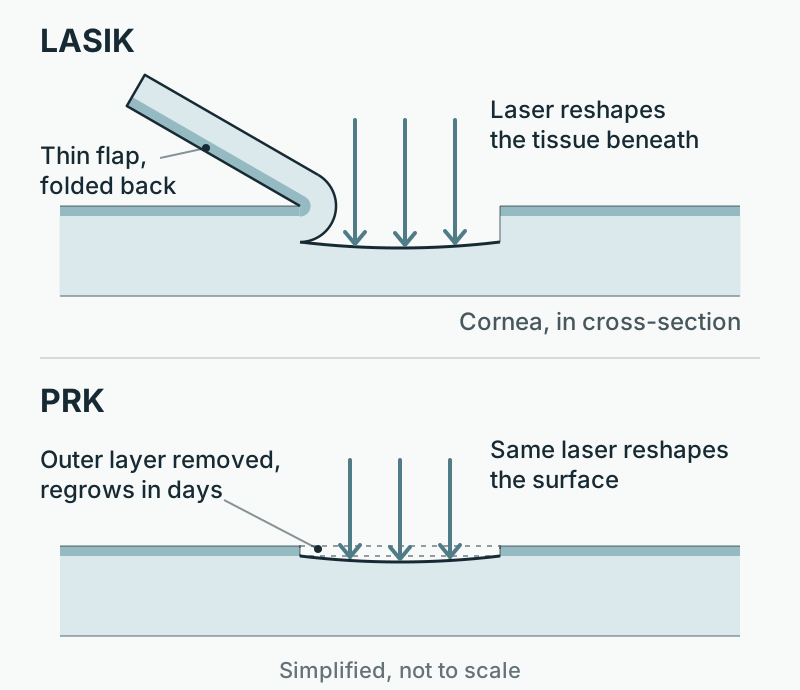
Everything else people compare, from recovery to who each one suits, follows from that one difference.
PRK recovery time, compared with LASIK
LASIK recovery is quick. Most of my patients see clearly the next morning, pass the driving standard, and feel ready for work.
PRK recovery asks for more patience, because the surface has to rebuild before vision settles.
- Days one to five. The regrowing surface can feel scratchy and light-sensitive. Audiobooks are often easier than screens.
- Days five to seven. The bandage lens comes out at your follow-up visit, and most patients see clearly again.
- The first month. Vision keeps sharpening, steadily.
- By three months. PRK vision reaches the same destination LASIK patients enjoy.
That matches what I see: blurry at first, better over three to five days, and a month or longer to reach your best vision.
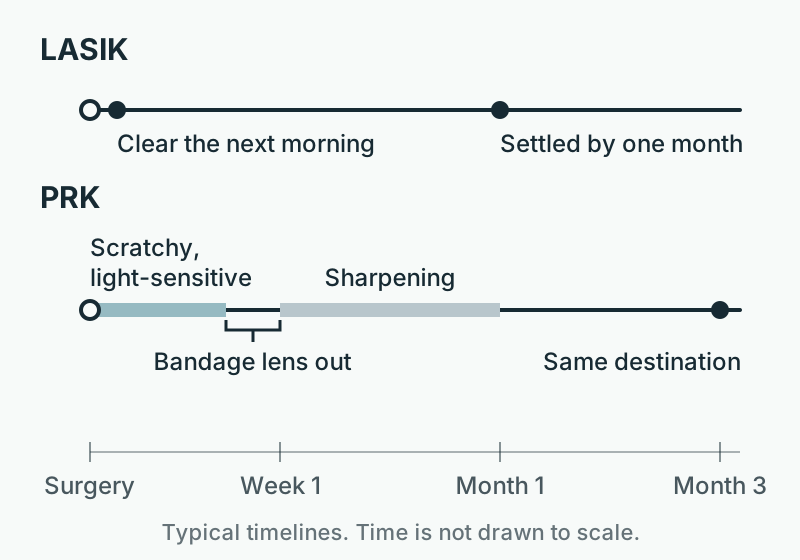
Plan on three to four days away from work after PRK. After LASIK, most people are back the next day.
Either way, the destination is the same. PRK simply takes the scenic route.
What the first week of PRK feels like
The healing days can feel a bit uncomfortable. Drops, rest, and oral medication when needed help manage them well.
The Academy also asks PRK patients to avoid strenuous activity for up to a week, and to wear sunglasses outdoors.
I suggest setting the week up before surgery day: a ride home arranged, audiobooks queued, and sunglasses by the door.

Why active lifestyles often point to PRK
For most desk-and-weekend lives, LASIK’s quick recovery is the deciding factor, and it is an excellent choice.
A very active lifestyle or job can change that. PRK may be the better option there, because there is no flap.
In my practice, that usually means work or sport with a real chance of a blow to the eye.
- Military service and first-responder work
- Martial arts, wrestling, and other contact sports
- Work around flying debris or impact, on a farm, a ranch, or a job site
Once PRK has healed, there is no flap to protect. The rebuilt surface is simply your cornea.
That is worth a slower first week for the people whose days include taking one to the face.

PRK vs LASIK for military and first-responder careers
The FDA’s page When is LASIK not for me? adds a practical step for anyone in a regulated job.
Some jobs prohibit certain refractive procedures, so it advises checking with your employer, professional society, or military service first.
Do that before your consultation if you can. It saves a second conversation later.
Thin corneas and other reasons PRK may fit better
PRK preserves more corneal tissue, because there is no flap to make.
So when corneas are thinner, or shaped in a way that makes a flap less advisable, PRK is often the better plan.
The Academy says the same: with thin corneas, PRK may be a good choice, because procedures such as LASIK are not recommended then.
Dry eye matters here too. When dry-eye risk factors make a flap-based procedure less desirable, PRK may be the better fit.
I explain why in Dry Eyes and LASIK, including why I treat dryness before planning any laser procedure.
Some patients arrive expecting a no after being turned away from LASIK elsewhere, and leave with a PRK plan instead.
It is one more reason the corneal maps get drawn before any recommendation is made.
Is PRK better than LASIK?
Neither one wins outright. Once healed, PRK reaches the same destination, and its long-term results can be just as strong.
The Academy reports that about 9 in 10 people who have PRK end up with 20/40 vision or better without glasses or contacts.
Neither procedure stops the natural lens inside your eye from aging. Reading glasses tend to arrive in your early forties either way.
Some people choose monovision with either procedure: one eye set for distance, the other left slightly nearsighted for close work.
Monovision is not for everyone, so it is worth trying first with contact lenses.
So the better surgery is the one that fits your corneas, your work, and how much downtime your next month can absorb.
PRK vs LASIK cost
Cost is part of the consultation too, and I only quote after your eyes are measured.
The FDA notes that most medical insurance will not pay for refractive surgery, so plan on FSA or HSA funds or financing for either one.
If you want to see how that number is built first, I wrote about what drives LASIK cost in Omaha.
Choosing between LASIK and PRK in Omaha
At Aviva, the choice begins with measurements. I look at the shape and thickness of your corneas, and the health of your tear film.
Then we talk about your work, your sports, and what the next month of your life looks like.
Bring your current glasses, any old prescriptions, and your employer’s policy on eye surgery if your job has one.
If neither laser fits, the conversation does not end there. EVO ICL or refractive lens exchange may still be a good path.
Usually, you do not have to choose. Your eyes do, and I will show you why in your own numbers.
Book a complimentary consultation and bring how you actually live: the mat, the combine cab, the fire station, or the Saturday pickup game.
Questions, answered
Is PRK as accurate as LASIK?
It uses the same type of laser to do the same reshaping.
Once healed, PRK results can be just as strong as LASIK results for well-matched eyes.
The difference is the healing road, not the destination.
How long before I can train or compete after PRK?
Plan on no strenuous activity for up to a week after PRK.
Contact sports wait longer. I will map a return-to-play timeline around your sport at your consultation.
Does PRK hurt?
The procedure itself does not. Numbing drops keep it comfortable.
The first few days of healing can be scratchy and light-sensitive. Drops, rest, and oral medication when needed keep it manageable.
Why would anyone pick LASIK over PRK?
Speed. Clear vision the next morning is hard to beat for desk-based lives.
It is a lifestyle decision more than a quality one, which is exactly why it deserves a real conversation.
More from Learn
 Procedures
Vision Surgery in Your 40s and 50s: LASIK After 40, Monovision and RLE
After 40, the reading-glasses problem changes the vision surgery conversation. LASIK, monovision, blended vision, and RLE, matched to the decade you’re in.
 Procedures
Choosing Your Cataract Lens
Multifocal, Trifocal, Extended Depth of Focus, Light Adjustable, and Toric Lenses Compared
 Procedures
Is LASIK Worth It? The 20-Year Math vs Contacts and Glasses
Contacts and glasses are a subscription you never stop paying. How I walk patients through the twenty-year math, what LASIK really buys, and how long LASIK lasts.