
ICL vs LASIK: The Better Fit for High Prescriptions
LASIK reshapes your cornea. The EVO ICL adds a lens inside your eye. For strong prescriptions, the difference decides everything. Here is how to think about it.

Here is how I weigh the EVO ICL against LASIK when a prescription is strong.
It is not uncommon for someone to sit in my Omaha consultation room believing they are unfixable.
A prescription in the high negatives. Corneas on the thin side. A LASIK “no” from years ago.
They are rarely unfixable. They were usually just in the wrong conversation.
LASIK and the EVO ICL solve the same problem from opposite directions.
Understanding the difference is how you find your answer.

EVO ICL vs LASIK: two philosophies, one goal
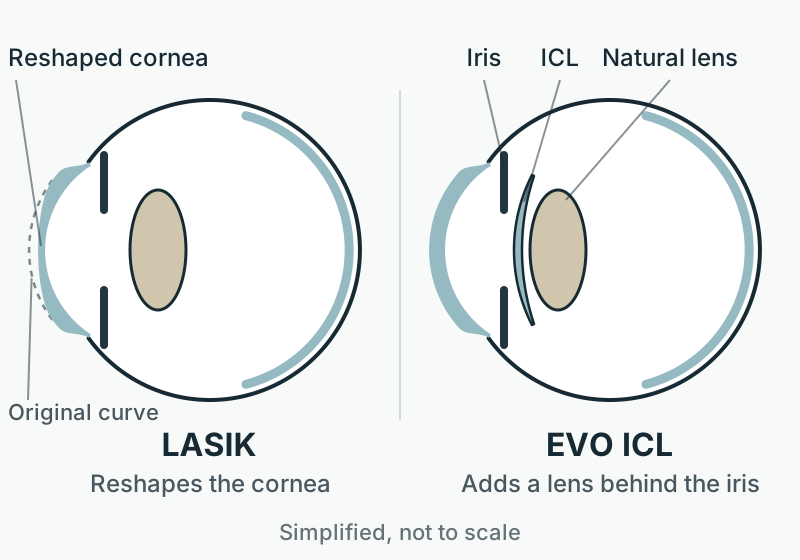
LASIK reshapes your cornea so light focuses correctly.
The ICL places a micro-thin lens inside your eye, in front of your natural lens.
An added lens is removable. Both are quick outpatient procedures with fast visual recovery.
Both have decades of refinement and excellent track records behind them.
For average prescriptions, the surgical difference rarely matters.
For strong ones, it is the entire decision. The right choice is written in your measurements.
Where LASIK hits its limits
Strong prescriptions ask the laser to reshape the cornea more. Thin corneas have less to give.
Push past the safe margin and you trade one problem for a worse one.
That is where many LASIK “no”s come from:
- Very high nearsightedness, beyond what tissue reshaping can safely correct
- Corneas that are thin, irregular, or borderline on the maps
- Significant dry eye that laser surgery could aggravate
I hear all three every month from Omaha patients who assumed vision correction was closed to them.
If any of those sound familiar, the ICL conversation is the one to have.
Told you are not a candidate for LASIK?
The FDA keeps a plain-language page on when LASIK is not for you. Its list overlaps with mine.
It explains that most refractive procedures change the eye’s focusing power by reshaping the cornea, for example by removing tissue.
Thin corneas are on its list of things your doctor should check for.
It also notes that LASIK tends to aggravate dry eyes, the third reason on my list.
None of that rules out life without glasses. It changes which procedure gets you there.
Where PRK fits in
Sometimes a LASIK “no” turns out to be a PRK “yes.” PRK uses the same laser, but lifts away a thin outer layer instead of making a flap.
With no flap, PRK preserves more corneal tissue. It can suit corneas that are thinner, or shaped in a way that makes a flap less advisable.
It still removes tissue, though, so it meets the same limit when a prescription is very strong or a cornea very thin.
What the ICL does differently
The ICL does not involve reshaping the cornea, so it corrects far stronger prescriptions than a laser safely can.
Your cornea stays exactly as it is, which matters for tear film and long-term flexibility.
The ICL itself is invisible to you and to everyone else.
Patients describe the quality of vision as unusually crisp, especially at night.
There is an engineering reason for that: the lens corrects light inside the eye, close to where focusing happens.
Glasses correct from an inch away, and stronger glasses shrink or warp the world at the edges. The ICL simply does not.

The EVO version also has a small central port, designed so the eye’s internal fluid keeps circulating naturally.
What is an implantable collamer lens?
ICL stands for implantable collamer lens: a soft, biocompatible lens placed gently inside your eye.
The FDA groups these implants under phakic intraocular lenses. Phakic means your natural lens stays where it is.
That is the difference from cataract surgery and refractive lens exchange, where the natural lens is removed and replaced.
A phakic lens can sit just in front of the iris or just behind it. The EVO ICL rests behind it, in front of your natural lens.
The FDA notes that every phakic lens it has approved is for nearsightedness. The EVO ICL covers it from moderate to very high.
ICL eye surgery vs LASIK: the day and the week after
Each one starts with numbing drops. After that, the two procedures part ways.
On the day
With LASIK, one laser creates a very thin flap in the cornea, and a second reshapes the tissue beneath it.
The flap is returned to its place and begins to seal naturally, without stitches. The procedure usually takes less than 30 minutes.
With the EVO ICL, your custom lens is folded and guided in through an opening smaller than three millimeters.
It unfolds on its own, and I position it behind your iris. The opening usually seals itself without a stitch.
The first week
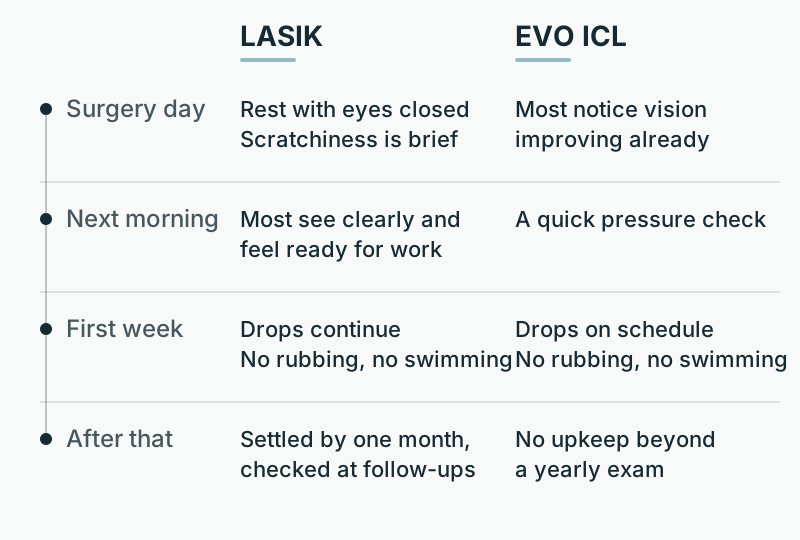
After LASIK, most patients see clearly the next morning and feel ready for work.
After the ICL, most notice their vision improving the same day, then come back the next morning for a quick pressure check.
Either way, the first week means drops on schedule, no swimming, and no rubbing your eyes.
From then on, the ICL needs no cleaning and no upkeep. A yearly exam is all it asks of you.
How the decision actually gets made
Not by preference. By measurement:
- Corneal testing, thickness, shape, and regularity, point by point
- Internal eye measurements, the space the ICL would occupy
- Tear film and surface health, the dry-eye question, answered honestly
- Your prescription stability over time
Where the numbers land tells us which procedure serves you, or whether both could.
When both are safe, lifestyle and philosophy break the tie.
Some patients love that LASIK is done and permanent. Others sleep better knowing the ICL could be removed or updated.
Neither instinct is wrong. They are just different relationships with the same goal.
Why a stable prescription matters
The FDA page I mentioned counts a change in your glasses or contact lens prescription within the past year against refractive surgery.
It calls that refractive instability, and it is why prescription stability sits on my list above.
It adds that instability is more likely in your early twenties or younger, and during pregnancy or breastfeeding.
Diabetes and some medicines can make vision fluctuate as well.
EVO ICL cost compared with LASIK
The ICL costs more than LASIK, and the reasons are specific rather than mysterious.
The lens is custom-ordered for each eye and sized from precise internal measurements. It is placed in a surgical suite, one eye at a time.
Follow-up care can also run longer than it does after a laser procedure.
Each of those pieces should appear, itemized, when you ask about EVO ICL cost in Omaha.
The comparison worth making is against years of high-index glasses and specialty contacts. Strong prescriptions are expensive to live with.
EVO ICL and LASIK in Omaha: get measured, not guessed at
At Aviva in Omaha, I walk you through your eye tests and what they mean.
You will hear which door your eyes point to, and why, in plain language.
A LASIK “no” somewhere else is not the end of the story. It is a reason to measure again.
Consultations are complimentary and nothing is scheduled until your questions run out.
If you have carried a strong prescription your whole life, an hour here can change the next few decades.
Your eyes have waited long enough for a real answer.
Book a complimentary consultation or compare the EVO ICL and LASIK pages side by side.
Strong prescriptions deserve strong answers. Aviva, we have them.
Questions, answered
Do you see many high prescriptions in Omaha?
Every week. Nebraska winters keep contact lenses in year round, and dry eye from that daily wear is common.
That combination is exactly where the ICL conversation tends to start.
What counts as a “high” prescription?
There’s no single line, but the stronger your nearsightedness, the more tissue LASIK must remove.
When the maps say removal isn’t safe, the ICL usually still is.
That judgment call is exactly what the measurement visit exists to make.
Is the ICL safe long term?
The EVO ICL has a long international track record and is FDA approved.
Like any surgery it carries risks, which Dr. Thornton reviews with you candidly before anything is scheduled.
Can the ICL fix astigmatism too?
Yes, toric versions of the lens correct astigmatism along with nearsightedness.
Your measurements determine the exact lens your eyes need.
I was told no to LASIK years ago. Is it worth re-checking?
Absolutely. Technology and options have moved, and the ICL serves exactly the eyes laser surgery couldn’t.
Bring the old records if you have them, the comparison is useful.
More from Learn
 Procedures
Vision Surgery in Your 40s and 50s: LASIK After 40, Monovision and RLE
After 40, the reading-glasses problem changes the vision surgery conversation. LASIK, monovision, blended vision, and RLE, matched to the decade you’re in.
 Procedures
Choosing Your Cataract Lens
Multifocal, Trifocal, Extended Depth of Focus, Light Adjustable, and Toric Lenses Compared
 Procedures
Is LASIK Worth It? The 20-Year Math vs Contacts and Glasses
Contacts and glasses are a subscription you never stop paying. How I walk patients through the twenty-year math, what LASIK really buys, and how long LASIK lasts.