
What to Expect at Your Vision Correction Consultation
The consultation is where your options get real. What we measure, what you’ll learn, and how to get the most out of an hour with your surgeon.

A LASIK consultation, or any vision correction consultation, is easier to book once you know what happens in the room.
The consultation is where I get to know you
Every good outcome I have delivered started the same way: by taking the time to truly understand you.
Your eyes, your health, your life, then measuring with precision and speaking with honesty.
If you have never had a surgical consultation before, not knowing what to expect can feel like the hardest part.
So here is exactly what happens when you come see me in Omaha, from start to finish.
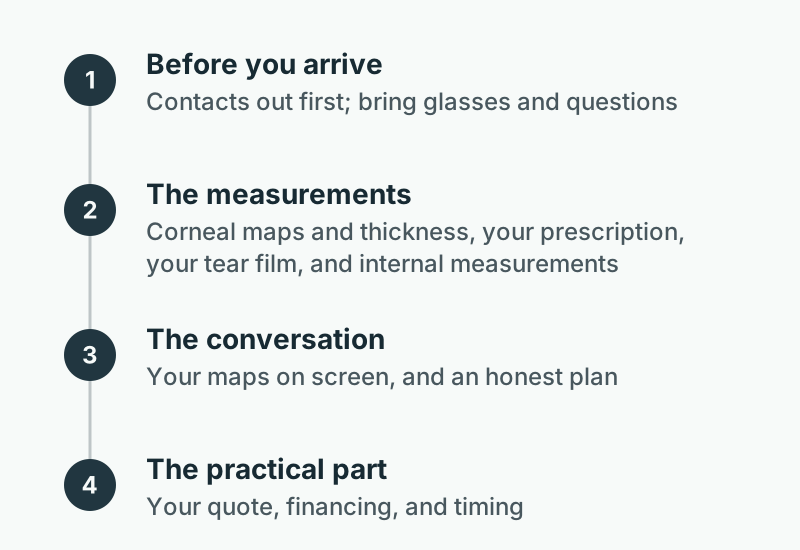
Before you arrive
There is one preparation that matters more than any paperwork: your contact lenses.
Contact lenses gently reshape your corneas over time.
Measurements taken while you are still wearing them daily reflect the lens, not the true shape of your eye.
I ask that you set aside soft contact lenses for three days beforehand. Toric and hard contact lenses need a longer break.
It is a small sacrifice that protects the accuracy of everything that follows.
If you are not able to be out of your contacts beforehand, we can still complete your initial screening.
I will simply measure your eyes again on the day of your procedure to make sure every detail is precise.
What to bring on the day
Please bring your current glasses, old prescriptions, and every question you have been saving.
Add a list of every medicine you take, over-the-counter ones included.
Some medicines can rule a procedure out or affect its results, so the complete list matters.
If you have had eye surgery or an eye injury before, bring whatever you know about it too.

There is truly no dress rehearsal needed. Come as you are.
The measurements: getting to know your eyes
The heart of the visit is a personalized evaluation centered on your eyes, your goals, and your lifestyle.
The tests themselves are also surprisingly interesting to watch.
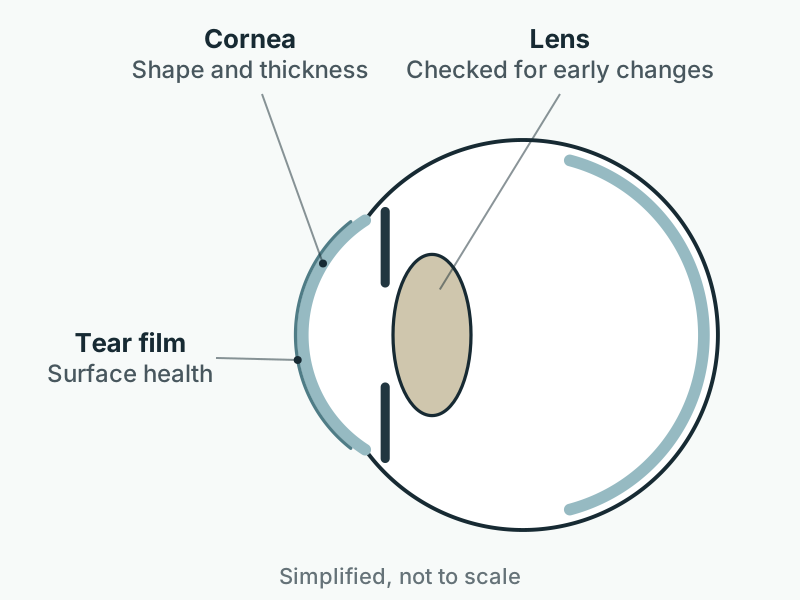
- Corneal topography: a detailed elevation map of each cornea’s shape and regularity
- Corneal thickness: tells us how much reshaping your eye can safely support
- Refraction: your precise prescription, measured rather than estimated
- Tear film and surface health: a gentle dry-eye check that helps protect your results
- Internal measurements and lens status: the remaining pieces that complete your full picture
None of it is uncomfortable. The most you will be asked to do is rest your chin and look softly at a light.
Each scan takes seconds, and together they tell me more about your eyes than words alone ever could.

Why corneal topography and thickness matter
The American Academy of Ophthalmology’s overview of LASIK lists the core of it: your overall eye health, your corneas, and your prescription.
The corneal maps do more than decide candidacy. With LASIK, those measurements are what the laser is programmed with.
That is why accuracy matters so much, and why contact lenses come out first.
The internal measurements serve the other paths: they size an EVO ICL.
The lens check shows whether your natural lens has started to change, which matters more after 40.
Why the tear film check matters
Dry eyes can feel worse after LASIK, so a dry surface is something to find before any laser is planned.
Often the answer is to treat dry eyes before LASIK and measure again once the surface has settled.
Long screen days and Nebraska wind are both hard on the tear film.
The conversation: an honest, unhurried discussion
Once we have your maps, I sit down with you myself, and this is the part of the visit I care about most.
This is not a hurried summary delivered by someone else. It is a real conversation, with your surgeon.
You will see your own corneas on screen, and I will walk you through what everything means in plain language.
If you are a strong candidate for LASIK, I will show you why, in your own numbers.
If you are not, I will tell you honestly, and we will talk through what may fit better instead.
That could be PRK, the EVO ICL, or lens exchange.
Your candidacy is never a sales conversation here. It is simply why I take the time to get to know you.
It is why my staff measures your eyes so carefully in the first place.
It is not uncommon that a patient who comes in expecting one procedure leaves with a different plan.
One that is genuinely better matched to their eyes. That means the consultation did exactly what it was meant to do.
Am I a candidate for LASIK?
The broad strokes are simple. Your prescription should have held steady for about a year.
You should be at least 18, and ideally over 21, when vision is more likely to have stopped changing.
Your corneas need enough thickness and a healthy shape, and your eyes need to be healthy overall.
Significant dry eye, or a prescription beyond what a laser can safely treat, points toward a different procedure.
Setting honest expectations
We also talk about how you actually use your eyes, from screens and night driving to sports and the fine print of your job.
LASIK lets people do most of their everyday tasks without glasses, though some still want them for reading or night driving.
Knowing that before you decide is part of deciding well. Your hobbies and your patience for readers belong in that conversation too.
The practical part: costs and timing
Once we know your plan, my staff will walk you through your quote.
We will also review financing, FSA, and HSA options together that same day, so you leave with real numbers, not guesswork.
You will hear honest guidance on timing too: how soon surgery could happen, and what your recovery will realistically ask of your schedule.
Nothing is booked in that room unless you feel ready for it to be.
Choosing when to have surgery
Timing is partly about your eyes, not only your calendar.
Vision tends to shift during pregnancy, breastfeeding, or menopause, and again after 40 as presbyopia begins.
If one of those applies to you, we talk through whether waiting makes sense.
Some people simply wait for a quieter month at work, and that is a fine reason too.
Recovery shapes the date too: after LASIK most people feel ready for work the next morning, while PRK asks for a few days off.
Questions worth bringing to your LASIK consultation
Please bring the questions you have been told are silly, too. They never are.
The Academy’s list of questions to ask when considering LASIK is a good place to start. These are the ones I would bring:
- Is my prescription within the range LASIK is approved to treat?
- Have my eyes been stable for the last year or so?
- Do I need 20/20 for everything I do, or would 20/40 be good enough?
- How long will recovery take, and what will I need to adjust?
- If the result falls short of the goal, what would a retreatment involve?
- What does it cost, including any related treatment later?
Book yours whenever you are ready, or browse the procedures first.
A consultation can give you a lifetime of knowing exactly where your eyes stand.
Even if the answer is not yet or not this procedure, you will leave understanding why, and that alone makes the visit worthwhile.
Good decisions about your eyes begin with really being known. That is where this starts.
Questions, answered
How long is the consultation?
About an hour. That is enough time to measure thoroughly and talk without a countdown running.
It ends when your questions do, not when a schedule says so.
How long do I need to be out of contacts first?
Typically three days for soft lenses, longer for toric and rigid ones.
We will give you an exact window when you book, based on what you wear.
Will my eyes be dilated?
It depends on your specific consultation. We will confirm this when you schedule.
If dilation is recommended and you cannot be dilated that day, we can work around it and keep your consultation time.
If you are being dilated, plan to bring sunglasses, and a driver if that feels more comfortable for you.
Am I committing to surgery by coming in?
Not at all. The consultation exists to help answer the question, not to assume the answer for you.
Some patients take what they learn home to think it over. That is exactly how it should work.
More from Learn
 Practice & Patient Info
Does Insurance Cover LASIK, EVO ICL or Refractive Lens Exchange? FSA, HSA, and Financing
Most health insurance does not cover LASIK, EVO ICL, or refractive lens exchange. Here is what insurance actually covers, and how FSA, HSA, and financing close the gap.
 Practice & Patient Info
Welcome to Aviva: A New Kind of Eye Care in Omaha
Aviva is open. Ivey Thornton M.D. on why Omaha didn’t need one more eye practice, it needed a different one.